




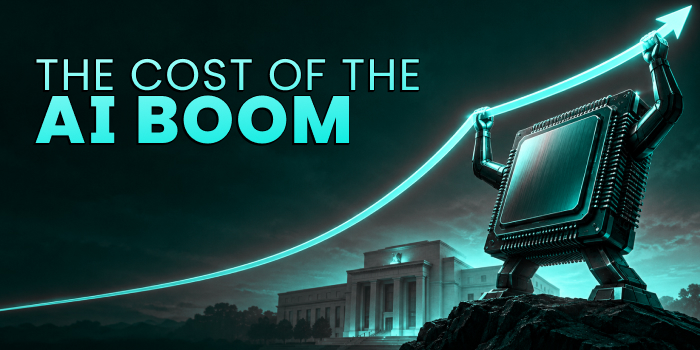
The Cost of Capital in an AI Investment Boom
There’s a belief that artificial intelligence will make workers far more productive. That more output from the same inputs will push inflation down, and central banks will likely cut rates. It’s a tidy chain of logic which comes with a historical anchor people love to cite: the 1990s, when Alan Greenspan supposedly saw the productivity boom coming and let the economy run.
One issue is that the history points the other way. Matt Klein, who writes The Overshoot and has spent a lot of time with the Greenspan-era Fed transcripts, makes the case this way: If you rerun the 1990s tape, the lesson is higher real interest rates. That matters for anyone holding bonds, pricing equities, or trying to guess where the Fed goes next.
Greenspan Saw the Boom About a Year Before the Data
The legend of Greenspan the visionary is a little generous. Computers and the early internet were visible everywhere by 1995, but the productivity statistics didn’t start accelerating until 1997. Greenspan began making his argument in the middle of 1996. He was ahead of the official numbers, just not by much.
Compare that with today, as there’s no meaningful productivity acceleration in the data yet. Every forecast of an AI-driven surge, however plausible, is still a forecast. That simply means anyone pricing it in now is further out on a limb than Greenspan ever was.
What Rates Did When Productivity Took Off in the Late 1990s
Three details from that decade tend to get lost. The first is the starting point. Interest rates before the boom were substantially higher than they are today, even though inflation was running lower. Nominal growth was about the same, because real growth was stronger.
The second is what happened next: Once productivity picked up, real interest rates rose. The measurement is fuzzy, since inflation-protected Treasuries were brand new, but the direction seems clear, and there’s a reasonable argument they didn’t rise enough. That’s what theory would predict. When a technology suddenly makes many investments more attractive, demand for capital climbs, expected returns climb, and the price of money should follow.
The third is that inflation didn’t fall much because of productivity. The 1990s boom showed up mostly as faster growth. Whatever disinflation the decade enjoyed came from other places: commodity prices collapsing during emerging market crises, Japan sinking through its post-bubble slump, and a rising dollar cheapening imports. None of that had anything to do with computers.
Today, several forces run in the opposite direction. Since COVID and the wars in Ukraine and Iran, countries have been stockpiling physical goods and building up domestic productive capacity. That leans inflationary, or at least reverses the tailwind of the 1990s, so even a perfect repeat of the productivity story wouldn’t bring a perfect repeat of the inflation story.
From Electric Motors to Driverless Cars, Diffusion Takes Time
New technologies take a long time to reach the productivity numbers. Electricity is the classic example, as factories had electric motors for decades before managers figured out how to redesign their processes around them.
AI may move faster, but there are bottlenecks as long as people are the ones deciding how to adopt it. Software engineers were early adopters because the tools are good at writing code. Whether that gain has more room to run, and whether other industries can find comparable uses, are open questions. Software is a small slice of the economy, and lifting productivity across the whole of it is a much harder problem.
Driverless cars offer a useful picture. In San Francisco they’re everywhere and unremarkable, while in much of the world people don’t know the technology works at scale. The gap between a thing existing and a thing being used is where most of the waiting happens.
Output per Hour Is a Rough Estimate Dressed Up as a Statistic
Economy-wide productivity isn’t something anyone measures directly. Statisticians take total spending or income, deflate it with an inflation measure, and divide by an estimate of hours worked. Each of those inputs carries error, and the ratio can swing for reasons that have nothing to do with doing more with less.
The pandemic showed how badly this can mislead. When millions of lower-paid restaurant and retail workers lost their jobs in 2020, the remaining workforce skewed toward higher earners, and measured productivity jumped even though nobody was doing their job any better. When those workers were rehired, productivity appeared to fall.
The San Francisco Fed tries to strip out these distortions by separating the effects of a more experienced workforce, more machinery per worker, and people working harder when the economy runs hot. What’s left is an estimate of underlying productivity. By that measure, growth has been roughly zero over the past 18 months or so. For now, people seem to be working harder rather than smarter, which is the opposite of what you’d guess from watching the technology.
Why a 5% Treasury Yield Looks Light Against 7% Nominal Growth
The same framework helps explain the bond market.
If you lock up money for 30 years at a fixed rate, the return you’ll accept depends on the alternatives, whether that’s holding cash and rolling it over or owning risky assets with uncapped upside. With the U.S. economy growing around 7% a year in dollar terms, a 5% fixed return for three decades only makes sense if you expect growth to slow sharply. Maybe it will, but that’s a bet rather than a default.
Seen this way, rising yields reflect stronger growth and sticky inflation more than anything alarming. Headlines about the highest rates in 19 years miss that many of those 19 years were bad ones, and low rates were a symptom. Japan’s 10-year yield hitting a 30-year high tells a similar story. After decades of zero growth in yen terms and falling prices, Japan appears to have escaped, and higher rates are part of what escape looks like.
Deficits matter mainly through their effect on nominal growth. For a country that borrows in its own currency, the danger runs toward inflation rather than default. The bad version looks like Brazil, with very high real rates and heavy interest costs, stuck in an equilibrium born of past hyperinflation. The U.S. is nowhere near that.
The 1990s Capex Bust Was Real, but Today’s Spending Leaks Abroad
The 1990s weren’t only a stock market bubble. Real net investment, adjusted for depreciation and inflation, grew faster than in any sustained stretch since the data began in 1929, and industrial capacity expanded at a nearly unprecedented pace even outside tech.
When that spending collapsed, the damage was deep enough that policymakers leaned on housing to fill the hole. That wasn’t a sustainable fix, and growth through the 2000s stayed anemic anyway, which tells you how large the gap left by business investment had become.
The difference now? Where the money goes. In the 1990s, most of the equipment was made at home. Today, much of the incremental spending on data centers flows to Taiwan and Korea as imports. A slowdown would still hurt, especially equity valuations, but the idea that the U.S. economy rises or falls entirely on AI capex overstates the case.
Productivity Booms Bring Growth and Expensive Capital Together
The broader lesson is about humility with analogies. The 1990s are a useful reference, but only if you read them honestly. Productivity booms have historically produced more growth, more demand for capital, and higher real rates. They haven’t been a reliable engine of disinflation.
For investors, that means being skeptical of any story where a technological revolution delivers booming growth and cheaper money at the same time. Those two things usually pull against each other. Sometimes rising rates are a warning, and sometimes they’re the price of an economy that finally works. It pays to know which one you’re looking at.
DISCLAIMER: This article is based on a conversation from Top Traders Unplugged and reflects themes, ideas, and perspectives discussed during the episode. The views expressed are those of the guest and participants in the conversation and should not be interpreted as investment advice or as the official views of Top Traders Unplugged.
To receive future episodes, research, and weekly insights from the world of investing, macro, and trend following, sign up for our newsletter or subscribe on your preferred podcast platform.
Most Comprehensive Guide to the Best Investment Books of All Time

Most Comprehensive Guide to the Best Investment Books of All Time
Get the most comprehensive guide to over 600 of the BEST investment books, with insights, and learn from some of the wisest and most accomplished investors in the world. A collection of MUST READ books carefully selected for you. Get it now absolutely FREE!
Get Your FREE Guide HERE!